Information Technology
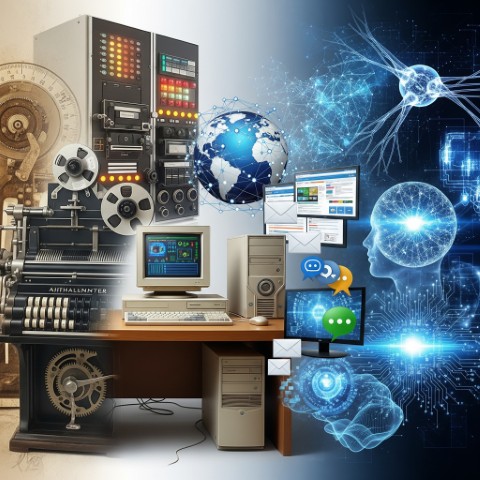
The Evolution of IT: From Early Calculators to the Age of AI
Let’s strip out the marketing fluff and look at the technical journey. Information Technology—once a fancy term for “faster math” now sits at the core of pretty much every system shaping our lives. Here’s how we got from sliding beads to quantum bits.
- Historical Progression: The Machinery Behind the Buzzwords
Ancient tools like the abacus (think: hardware-level integer calculator, ~3000 BCE) laid the foundations. Mechanical calculators followed—Pascal’s gear-driven device in the 1600s, Babbage’s Analytical Engine in the 1800s (never built, but the architecture was all there: memory, control unit, input/output).
By the late 19th century, punch cards arrived, offering a form of programmable storage and semi-automated data processing—see Hollerith’s tabulator, the spiritual ancestor of modern batch computing.
The 20th century is where theory meets silicon. Turing’s 1936 paper gave us the model for general computation (Turing Machine—limited only by memory and time). ENIAC, fired up in 1945, was the first electronic, general-purpose computer. Transistors (1947) replaced vacuum tubes, kicking off Moore’s Law and the relentless miniaturization of hardware.
ICs and microprocessors in the ’60s and ’70s made personal computing feasible—Intel’s 4004 (1971) was the first commercial CPU-on-a-chip. The PC era exploded in the late ’70s and early ’80s (Apple II, IBM PC), while ARPANET’s birth in 1969 set the stage for the Internet—eventually morphing into the World Wide Web thanks to Tim Berners-Lee in 1989.
The ’90s-2000s were pure acceleration: the dot-com boom, the rise of Google’s search algorithms, Amazon’s e-commerce, and then the smartphone era (iPhone, 2007) and cloud computing (AWS, 2006), which abstracted infrastructure into a service layer.
- Current State: IT as the Operating System of Society
Today, IT is an ecosystem of interconnected, modular technologies.
-
Artificial Intelligence & Machine Learning: We’re talking about deep learning models (CNNs, RNNs, LLMs like GPT) deployed for everything from medical diagnostics to autonomous vehicles. Automated decision-making pipelines are standard in finance, advertising, and logistics.
-
Big Data & Analytics: Distributed processing frameworks (Hadoop, Spark), noSQL databases, and real-time analytics (Kafka, Flink) enable organizations to mine petabytes of data for actionable insights—think Netflix’s recommendation engine or Google’s ad targeting.
-
Cloud & Edge Computing: Hybrid clouds leverage both on-prem and remote resources for scalability and redundancy. Edge computing pushes processing closer to data sources (IoT sensors, devices) to minimize latency—absolutely critical for real-time apps.
-
Cybersecurity: Threat landscapes now demand adaptive, AI-driven defense mechanisms—anomaly detection, behavior analytics, and automated incident response. Attack vectors are everywhere: ransomware, phishing, zero-days.
-
Internet of Things: Billions of connected endpoints (home automation, wearables, industrial sensors) generate continuous telemetry, enabling predictive maintenance and hyper-personalized experiences.
Impact? Workflows are remote-first (Zoom, Slack), communication is instant and persistent (social media, messaging), and entertainment is on-demand (streaming, VR/AR). Healthcare leverages telemedicine and AI-augmented diagnostics for precision and scale.
- Looking Forward: The Next Layer of Abstraction
Emerging tech is re-architecting the stack:
-
Artificial General Intelligence: Moving from narrow AI to systems that can generalize across domains—autonomous vehicles, legal reasoning, even creative tasks. Raises major questions around safety, bias, and job displacement.
-
Quantum Computing: Quantum bits (qubits) enable parallel computation at scales classical systems can’t touch. Use cases: cryptography, material science, complex optimization. IBM, Google, and D-Wave are in the race.
-
6G & Advanced Networks: Ultra-low-latency, high-bandwidth wireless is foundational for immersive AR/VR, autonomous systems, and massive IoT.
-
Blockchain & Web3: Decentralized, trustless architectures—smart contracts, NFTs, DAOs—aim to shift power from centralized platforms to peer-to-peer protocols.
-
Biotech & AI Integration: Brain-computer interfaces (Neuralink), genomic modeling, AI-driven drug discovery—blurring the line between data processing and biological systems.
The upshot? IT will automate routine labor, create new roles (data ethicists, AI trainers), and power smart cities, personalized education, and even autonomous space exploration. But the technical challenges are matched by ethical ones: privacy, algorithmic accountability, and governance.
Conclusion: IT’s Relentless Velocity
From mechanical calculators to AI-managed supercomputers, IT has become the backbone of civilization’s infrastructure. The future? Expect exponential change—quantum breakthroughs, smarter AI, and deeper human–machine integration. The ethical frameworks and technical standards we set now will shape the next century.